

Due to the increasing demands of our water resources, the Department of Public Utilities is providing the following information in an effort to educate and stress the importance of becoming more water efficient. A significant level of water conservation can be achieved without major changes in lifestyle. Simply watering landscapes properly and utilizing efficient plumbing fixtures and appliances in the home can reduce the per-capita water use by 25 percent.
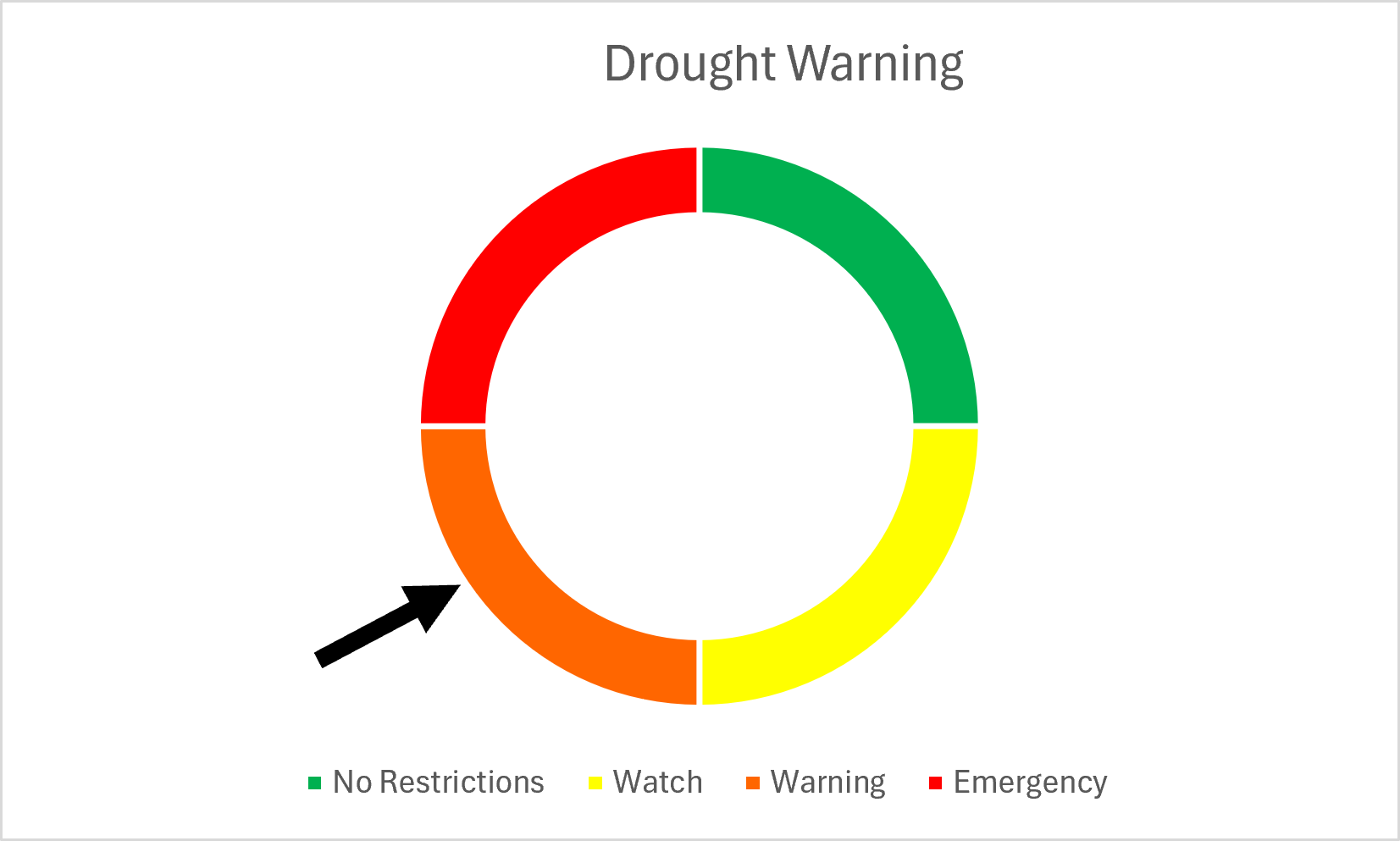
Current status:
Drought Warning
DROUGHT WATCH
Responses and Water Conservation Measures
Upon entering into the Drought Watch stage, these are regional actions to be taken by the respective localities. At a minimum, the listed water conservation measures will be encouraged during periods of declared drought watch. These measures will be implemented on an individual locality basis when an Upper Shenandoah River Basin local government declares a drought watch stage. It is possible that the increased public awareness of water conservation activities during a drought watch may reduce water use up to 5%.
- WHAT TO DO IN A DROUGHT WATCH
- A Drought Watch notification shall be publicized through the general news media or any other appropriate method for making such notification public.
- Localities will include water conservation information on their website.
- Localities will contact the Central Shenandoah Planning District Commission (CSPDC) office when a drought stage is implemented. The CSPDC will update the locality’s drought status on the regional drought website.
- All citizens, including private well users, will be encouraged to begin voluntary water conservation measures (see below).
- Localities will review and/or update the regional Drought Preparedness and Response Plan.
- Public waterworks and self-supplied water users who withdraw more than 10,000 gallons per day are asked to review and voluntarily implement existing drought water conservation methods as outlined in this plan.
- Locality staff will continue to monitor drought indicators on a monthly basis and report significant changes to local officials.
- Localities will increase water use efficiency and/or promote use reclaimed water for public facility landscaping.
- Localities may consider developing increased conservation rate charges or surcharges to respond to drought conditions.
- Continue conservation until water storage (source & distribution) is replenished.
Individual Water Conservation Measures (Outdoor)
- Use a broom instead of a hose to clean driveways, walks and patios.
- When swimming pools are not in use, reduce losses to evaporation by using a pool cover.
- Turn off ornamental fountains or other such structures, unless the water is recycled.
- Water the lawn at night or in the early morning to avoid evaporation.
- Mow lawns to two inches or more and leave the clippings. It will shade roots, provide nutrients and help retain moisture. Keep mower blades sharp to reduce water loss.
- Raise the lawn mower blade to at least three inches or to its highest level. A higher cut encourages grass roots to grow deeper, shades the root system, and holds soil moisture better than a closely clipped lawn.
- Use mulch around plants and other shrubbery to reduce evaporation. Mulch also helps control weeds that compete with landscape plants for water.
- Water slowly, deeply, thoroughly and infrequently to encourage root growth. Water deeply with a soil-soaker or drip irrigation.
- Remove weeds from vegetable and flower gardens to reduce competition for water.
- Water only when landscaping needs it. As a general rule, lawns only need one inch of water per week, less in the winter.
- Water trees and shrubs separately. Some only need to be watered once a month.
- Use a shut-off nozzle on hoses, which can be adjusted down to a fine spray so that water flows only as needed. When finished, turn it off at the faucet instead of at the nozzle to avoid leaks.
- Avoid over fertilizing lawns. Fertilizer applications increase the need for water. Apply fertilizers that contain slow-release, water-insoluble forms of nitrogen.
- Aerate regularly and use mulch to reduce evaporation.
- Plant native or drought-tolerant grass and plants.
- Check sprinkler systems in the spring to insure proper working order. Avoid watering walks, driveways, or the street.
- Check sprinkler systems regularly for leaks.
- Use a bucket to wash cars instead of a hose or consider using a commercial car wash that recycles water.
- Place rain barrels under gutter downspouts. They can collect rainwater for plants, car washing or general cleaning projects.
Individual Water Conservation Measures (Indoor)
- Verify that homes are leak free. Many homes have hidden water leaks. Read your water meter before and after a two-hour period when no water is being used. If the meter does not read exactly the same, there is a leak.
- Turn off the water while brushing teeth, washing your face or hands, and shaving.
- Replace old washing machines with a horizontal-axis machine that uses less water and energy. Wrap hot water heaters and pipes with insulating material.
- Avoid running the tap for a cold drink. Keep a pitcher of water in the refrigerator.
- Install faucet aerators, which reduce wastewater by mixing water and air.
- Take showers rather than baths.
- Limit showers to once a day for five minutes and do not fill bathtubs more than 1/3 full for baths.
- While showering, turn off the water when soaping up.
- Do not use your toilet as a trash can. Throw things away instead of flushing them down the drain.
- If your home is more than five years old, the chances are your toilet is using more water than necessary and could operate with less water. To lower the amount of water used for each flush, your need to displace water in the toilet tank. Two ways to displace water are listed below.
- Place toilet dams in the tank. They hold back water and prevent it from leaving the tank. Dams can be purchased at your local hardware store.
- Use pop bottles or a plastic jug to displace the water in your tank so that there is less water flowing into the bowl. Fill the bottle with water or place rocks in the bottom of the container for weight.
- Install a low-flow showerhead to reduce water use. To check the flow rate of your existing showerhead, turn the shower on all the way and see how long it takes to fill a one-gallon bucket. If your showerhead fills a one-gallon container in less than 15 seconds, it is using more than 4 gallons per minute (gpm) of water. When buying a showerhead, be sure that it delivers no more than 2½ gallons per minute; 1½ to 2gpm is even better.
- Do not use a garbage disposal.
- Do not rinse dishes prior to putting them into an automatic dishwasher. Instead, wipe them with paper napkins from the meal or use a partially filled sink to do any necessary pre-washing.
- Run the dishwasher (and washing machine) only when they are full.
- If washing dishes by hand, rinse them in a half-full basin or pan instead of under running water.
- Dispose of paper and excess food in the garbage rather than the garbage disposal. Garbage disposals may add 50 percent to the volume of solids in a septic tank, which can lead to malfunctions and maintenance problems.
- Fill the washing machine with a full load of laundry. If your machine has a water level selector, make sure it is always set to match the amount of laundry being washed.
Commercial Conservation Measures
- Implement voluntary water reduction and conservation plans.
- Discontinue use of decorative fountains.
- Require commercial facilities with monthly demand exceeding a threshold limit to conduct a self-audit.
DROUGHT WARNING
Responses and Water Conservation Measures
Upon entering into the Drought Warning stage, these regional actions are to be taken by the respective localities. At a minimum, the listed water conservation measures will be encouraged during periods of declared Drought Warning. These measures will be implemented on an individual locality basis when an Upper Shenandoah River Basin local government declares a drought warning stage. It is intended that water conservation measures listed will generally result in reductions of water use of 5 to 10%.
- WHAT TO DO IN A DROUGHT WARNING
- A Drought Warning notification shall be publicized through the general news media or any other appropriate method for making such notification public.
- Localities will include water conservation information on their website.
- Localities will contact the Central Shenandoah Planning District Commission (CSPDC) office when the Drought Warning stage is implemented. The CSPDC will update the locality’s drought status on the regional drought website.
- All citizens, including private well users, will be encouraged to voluntarily reduce or eliminate non-essential water uses and follow the water conservation measures (Appendices C & D).
- Public waterworks and self-supplied water users who withdraw more than 10,000 gallons per day will initiate voluntary water conservation measures (Appendices C & D).
- All local government offices and institutions will initiate the reduction or elimination of non-essential water uses with the goal of reducing water usage by 5% to 10%.
- Localities will be encouraged to review existing local ordinances requiring mandatory non-essential water use restrictions or adopt such ordinances.
- Locality staff will continue to monitor drought indicators on a monthly basis and report significant changes to local officials.
- Continue conservation until water storage (source & distribution) is replenished.
Individual Water Conservation Measures
- Reduce lawn watering to no more than 2 times a week, between the hours of 9:00 p.m. and 10:00 a.m.
- Reduce vegetable garden watering by watering only when needed, between the hours of 9:00 p.m. and 10:00 a.m.
- Apply water directly to plants by using soil-soakers or drip irrigation. Avoid use of sprinklers.
- Do not plant new landscaping or grass.
Commercial Conservation Measures
- In addition to those measures listed under Appendix C:
- Implement water conservation plan.
- Implement interior retrofit for all high water use faucets and materials.
- Restrict washing of sidewalks, driveways, parking lots or any other paved surface except in the case of meeting health and safety standards.
DROUGHT EMERGENCY
Responses and Water Conservation Measures
Upon entering into the Drought Emergency stage, these regional actions are to be taken by the respective localities. At a minimum, the listed water conservation measures will be encouraged during periods of declared Drought Emergency. These measures will be implemented on an individual locality basis when an Upper Shenandoah River Basin local government declares a drought emergency stage. It is intended that water conservation measures listed will generally result in reductions of water use of 10 to 15%.
- WHAT TO DO IN A DROUGHT EMERGENCY
Drought Emergency Responses (Locality, Commercial, Individual)
- A Drought Emergency notification shall be publicized through the general news media or any other appropriate method for making such notification public.
- Localities will include water conservation information on their website.
- Localities will contact the Central Shenandoah Planning District Commission (CSPDC) office when the Drought Warning stage is implemented. The CSPDC will update the locality’s drought status on the regional drought website.
- All citizens, including private well users, will initiate the mandatory non-essential water use restrictions listed below and follow the water conservation measures in Appendices C & D.
- Public waterworks and self-supplied water users who withdraw more than 10,000 gallons per day will initiate the mandatory non-essential water use restrictions listed below and follow the water conservation measures in Appendices C & D.
- All local government offices and institutions will initiate the mandatory non-essential water use restrictions listed below with the goal of reducing water usage by 10 to 15%.
- Localities will be authorized to adopt local ordinances to enforce the mandatory non-essential water use restrictions listed below and to establish, collect, and retain fees for violations of these restrictions.
- Locality staff will continue to monitor drought indicators on a monthly basis and report significant changes to local officials.
- All users continue conservation until water storage (source & distribution) is replenished.
- Commercial customers are to follow the mandatory non-essential water use restrictions listed below, where appropriate.
- All other residential, business and industrial water users; whether supplied by public water supplies, self-supplied sources, or private water wells; who do not normally utilize water for any of the non-essential uses listed below are requested to voluntarily reduce water consumption by at least 10%. This reduction may be the result of elimination of other non-essential water uses, application of water conservation practices, or reduction in essential water uses.
Non-Essential Water Uses
The following non-essential water uses will be prohibited during periods of declared drought emergencies. Below each non-essential use is a list of exceptions. These prohibitions and exceptions will apply to uses from all sources of water and will only be effective on an individual locality basis when an Upper Shenandoah River Basin local government declares a Drought Emergency. The conservation measures listed in Appendices C and D of the Upper Shenandoah River Basin Drought Preparedness and Response Plan become mandatory during the Drought Emergency stage.
Local governments and public waterworks may impose water use restrictions more or less stringent than the mandatory non-essential water use restrictions listed below consistent with local water supply conditions at any time. Nothing contained in this drought response plan should be construed to limit the powers of the local governments to adopt and enforce local emergency ordinances as necessary to protect the public welfare, safety, and health.
Water use restrictions shall not apply to the agricultural production of food or fiber, the maintenance of livestock including poultry, nor the commercial production of plant materials so long as best management practices are applied to assure the minimum amount of water is utilized.
1. Unrestricted non-commercial watering (public or private)
Lawn Irrigation Exceptions:
- Newly sodded and seeded areas may be irrigated to establish cover on bare ground at the minimum rate necessary for no more than a period of 60 days. Irrigation rates may not exceed one inch of applied water in any 7-day period. Consider delaying seeding or sodding of new lawns.
- Gardens, bedding plants, trees, shrubs and other landscape materials may be watered with hand held containers not exceeding three (3) gallons in capacity. Watering may be done between the hours of 9:00 p.m. and 10:00 a.m. to avoid the heat of the day.
- Do not use sprinklers.
Golf Course Irrigation Exceptions:
- Tees and greens may be irrigated between the hours of 9:00 p.m. and 10:00 a.m. at the minimum rate necessary.
- Fairways may be irrigated between the hours of 9:00 p.m. and 10:00 a.m. at the minimum rate necessary not to exceed one inch of applied water in any ten-day period.
- All allowed golf course irrigation must be applied in a manner to assure that no runoff, puddling or excessive watering occurs.
Athletic Field Irrigation Exceptions:
- Athletic fields may be irrigated between the hours of 9:00 p.m. and 10:00 a.m. at a rate not to exceed one inch per application or more than a total of one inch in multiple applications during any ten-day period. All irrigation water must fall on playing surfaces with no outlying areas receiving irrigation water directly from irrigation heads.
- Athletic fields may be irrigated between the hours of 9:00 p.m. and 10:00 a.m. during necessary overseeding, sprigging or resodding operations at the minimum rate necessary for a period that does not exceed 60 days. Irrigation rates during this restoration period may not exceed one inch of applied water in any 7-day period.
- All allowed athletic field irrigation must be applied in a manner to assure that no runoff, puddling or excessive watering occurs.
- Irrigation is prohibited on athletic fields that are not scheduled for use within the next 120-day period.
2. Use of Fire Hydrants
Exceptions:
- Except for necessary governmental operations such as firefighting, health protection purposes, or certain testing and drills by the fire department as approved by the local government or waterworks operator
3. Washing of paved surfaces such as streets, roads, sidewalks, driveways, garages, parking areas, tennis courts, and patios; flushing of sewers and hydrants.
Exceptions:
- Surfaces may be washed with hand held containers not exceeding three (3) gallons in capacity. Washing should not occur during the heat of the day.
- As needed to ensure public health and safety and approved by the local government or waterworks operator.
4. Washing or cleaning of mobile equipment including automobiles, trucks, trailers, and boats
Exceptions:
- Mobile equipment may be washed at car washes that utilize reclaimed water as part of the wash process or reduce water consumption by at least 10% when compared to a similar period when water use restrictions were not in effect. Any facility operating a reclaimed water system must prominently display, in public view, a sign stating that such a recycling system is in operation.
- Mobile equipment may be washed using hand held containers not exceeding three (3) gallons in capacity or hand held hoses equipped with automatic shutoff devices provided that no mobile equipment is washed more than once per calendar month and the minimum amount of water is utilized.
- Automobile dealers and rental agencies may wash cars that are in inventory no more than once per week utilizing hand held containers not exceeding three (3) gallons in capacity, hoses equipped with automatic shutoff devices, automated equipment that utilizes reclaimed water as part of the wash process, or automated equipment where water consumption is reduced by at least 10% when compared to a similar period when water use restrictions were not in effect.
5. Use of water for the operation of ornamental fountains, artificial waterfalls, misting machines, and reflecting pools
Exceptions:
- Fountains and other means of aeration necessary to support aquatic life are permitted.
6. Filling and topping off outdoor swimming pools
Exceptions:
- Newly built or repaired pools may be filled to protect their structural integrity.
- Outdoor pools operated by commercial ventures, community associations, recreation associations, and similar institutions open to the public may be refilled as long as:
- Levels are maintained at mid-skimmer depth or lower,
- Any visible leaks are immediately repaired,
- Backwashing occurs only when necessary to assure proper filter operation,
- Deck areas are washed no more than once per calendar month (except where chemical spills or other health hazards occur)
- All water features (other than slides) that increase losses due to evaporation are eliminated, and
- Slides are turned off when the pool is not in operation.
- Swimming pools operated by health care facilities used in relation to patient care and rehabilitation may be filled or topped off.
7. Serving water in restaurants, clubs, or eating-places
Exceptions:
- May only be allowed at the specific request of the customer.
Severe Drought Emergencies
In some cases, the mandatory non-essential water use restrictions may not be sufficient to protect the supplies of an individual public waterworks. When an individual waterworks’ sources are so depleted as to threaten public health and safety, it may become necessary to ration water within that system in order to assure that water is available to support essential uses. Rationing water is a more severe measure than merely banning nonessential use of water. Under rationing, each customer is allotted a given amount of water, based on a method of allotment developed by the waterworks or local government. Generally, it will be based on a percentage of previous usage or on a specific daily quantity per household. Rationing is more likely to have some effect on welfare than mandatory non-essential use restrictions, because industrial and commercial water uses may be curtailed or eliminated to assure an adequate supply is available for human consumption.
The decision to ration water will typically be made by the local government or waterworks operator. Local government staff will work closely with any entity where water rationing is required to assure that all available State resources are effectively used to support these highly stressed water supply systems. The Virginia Department of Emergency Management (VDEM) is the first point of contact for waterworks or local governments who decide to ration water. VDEM will coordinate the Commonwealth’s response and assistance to such entities
- HOUSEHOLD CONSERVATION TIPS
Water-Saving Tips for Your Home
Kitchen
- Check faucets and fixtures for leaks.
- Install faucet aerators to reduce water use.
- Keep a pitcher of cold water in the fridge instead of running the tap.
- Skip rinsing dishes before loading the dishwasher—wipe food scraps into the trash or use a small basin for quick pre‑washing.
- Run the dishwasher only when it’s full.
- Limit garbage disposal use to reduce strain on septic systems.
Bathroom
- Turn off the water while brushing teeth, shaving, or washing your face and hands.
- Choose showers over baths.
- Keep showers to about five minutes, and turn off water while soaping up.
- Fill bathtubs no more than one‑third full.
- Avoid flushing items that belong in the trash.
Toilets
- Older toilets often use more water than necessary. Reduce water per flush by displacing tank water:
- Install toilet dams; purchased online or from a local hardware store;
- Place a filled or weighted bottle in the tank to reduce water volume.
Laundry
- Wash only full loads of laundry.
- Use the water level selector to match load size.
- Upgrade older machines to high efficiency using less water and energy.
Showers & Hot Water
- Install a low‑flow showerhead. If it fills a one‑gallon bucket in under 15 seconds, it uses more than 4 gpm. Choose showerheads rated at 2.5 gpm or less.
- Insulate hot water heaters and pipes to reduce heat loss.
Outdoor Water‑Saving Tips
Pools & Decorative Features
- Use a pool cover to reduce evaporation when the pool is not in use.
- Turn off ornamental fountains unless the water is recycled.
Lawn Care
- Water lawns at night or early morning to minimize evaporation.
- Keep mower blades sharp to reduce moisture loss.
- Set mower height to at least three inches to encourage deep roots and better moisture retention.
- Leave grass clippings on the lawn to shade roots, retain moisture, and add nutrients.
- Avoid over‑fertilizing, which increases water demand; choose slow‑release, water‑insoluble fertilizers.
- Aerate lawns regularly and use mulch to reduce evaporation.
- Plant native or drought‑tolerant grasses and plants.
Watering Practices
- Mulch around plants and shrubs to reduce evaporation and control competing weeds.
- Water slowly, deeply, and infrequently to promote strong root growth—soil soakers or drip irrigation work best.
- Water only when needed; most lawns require about one inch of water per week and even less in winter.
- Water trees and shrubs separately—many only need watering once a month.
- Use a hose shut‑off nozzle to control flow; after use, turn off water at the faucet to prevent leaks.
- Check sprinkler systems for leaks and adjust heads to avoid over spray onto sidewalks, driveways, or streets.
Car Washing & Rainwater Capture
- Use a bucket instead of a running hose when washing cars.
- Consider commercial car washes that recycle water.
- Place rain barrels under downspouts to collect water for plants, car washing, or outdoor cleaning.
Save water = Save Energy
You use energy to heat water and run appliances. Consider how much you use in key areas; the bathroom, kitchen and laundry.
- CONSERVATION PLANS
Drought Preparedness and Response Plan [870KB]